

What is a community-centered narrative?
What is a community-centered narrative?

Image by Asian Americans Attaining Awareness
A community-centered narrative ensures that those with lived experience - in this case, community members most impacted by structural racism and violence - are the storytellers that shape the data, stories, and solutions in relation to safety. Community members are the experts on their neighborhoods, and know about the strengths, assets, and needs that can be lifted up or that need to be addressed.
To further explain, we can explore each of the elements of a community-centered narrative:
-
We must recognize the importance of community broadly and inclusively. We define community both by geographic boundaries as well as groups with shared identities, such as immigrants and refugees or LGBTQ communities.
-
Within a complex ecosystem of power dynamics in any community or local jurisdiction, it is key to remember that community members are at the center of relationships with different groups, systems, and structures. Residents, particularly those with lived experience, are the center from which everything else radiates.
-
Narratives are the way we examine how people relate to each other and how to influence norms, systems, and policy. A narrative can build an accurate understanding of the situation and solutions to multiple audiences (e.g., media, policymakers, the public).
We recognize three important objectives of community-centered narratives:
-
Centering community to lead the conversation, strategy development and evaluation of the work to improve safety.
-
Holding decision makers to account to those they represent.
-
Building and maintaining momentum on local community safety strategies.
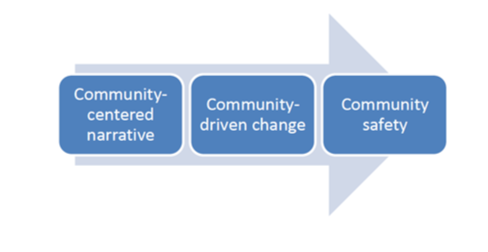
Community-centered narratives are a key element for moving us closer to equitable health, safety, and wellbeing in our communities. Narratives are powerful and can help community stakeholders embrace and advance community-driven change. This may incorporate many strategies, including policy and systems change, developing and strengthening government-community partnerships, and building multi-sector collaboration, among others.
Narrative change puts residents at the forefront of identifying strengths, assets, challenges, solutions, and metrics for positive change in their environment, which can lead to more representative and engaging efforts to improve community safety.
Note: The preceding information was adapted from research conducted by prevention Institute for the Annie E. Casey Foundation in 2022, and which formed the bases for a joint publication developed with FrameWorks Institute, Framing Community Safety: Guidance for Effective Communication.