

Applying research and data for continuous equity improvement
Applying research and data for continuous equity improvement
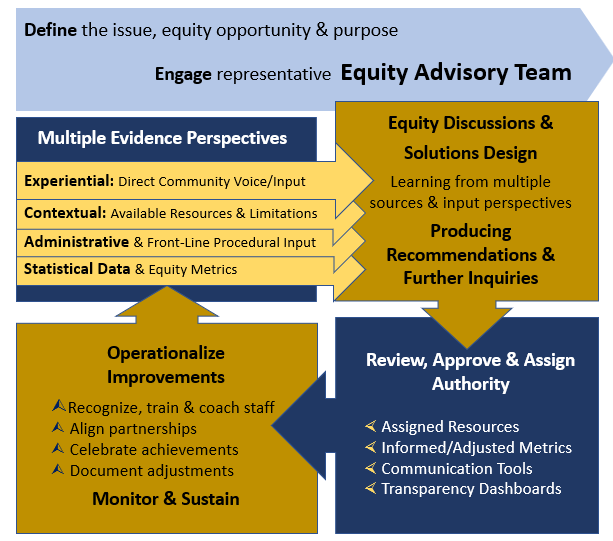
The image above depicts a continuous equity improvement cycle that begins with examining multiple evidence perspectives including experiential and contextual evidence; applies multiple sources and perspectives to design solutions; reviews, approves, and measures recommended actions; and operationalizes improvements. The cycle repeats over and over again to embed equity across all phases of policy, systems change, and resource development.
Importantly, the continuous equity improvement cycle applies multiple evidence perspectives including experiential and contextual evidence, drawn from CDC’s Evidence Project framework:
- Experiential Evidence is the collective insight, understanding, skill, and expertise of those who have practiced or lived in a particular setting over time. Some examples of data sources and methods for gathering experiential evidence include reflective questions, communities of practice, expert panels, and team decision-making and other consensus processes.
- Contextual Evidence is based on “factors that address whether a strategy is useful, feasible to implement, and accepted by a particular community.” Community history, organizational capacity, and social norms are some factors that may impact the success of a prevention strategy.
Resources
- The Veto Violence online training Understanding Evidence provides further insights on the best available research, experiential, and contextual evidence and how they can help you when making a decision about a violence prevention program, practice, or policy.
- Review the Center for Law and Social Policy’s Redefining Evidence-Based Practices: Expanding our View of Evidence to learn more about how an over-reliance on evidence-based practices alone can perpetuate structural inequities and the importance of developing new standards of program implementation and evaluation that are both data driven and community informed.
- The Urban Institute’s Centering Racial Equity in Measurement and Evaluation explores how racial equity and inclusion can strengthen nonprofits’ measurement and evaluation work and how measurement and evaluation help nonprofits identify inequities and use data to improve the operationalization of racial equity practices.