
The power of gathering: Building safe, equitable, and joyous futures through story sharing
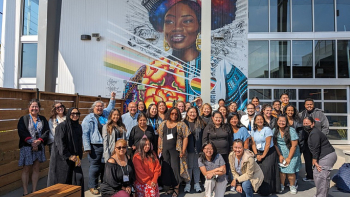
In September 2023, the Safety Through Connection (STC) and Leveraging Collaboration to End Domestic Violence (LCEDV) learning communities gathered in Prevention Institute’s Oakland office and the RYSE Center in Richmond under the theme of Thriving Community Ecosystems: Culture and Systems Change for Safety and Healing. This assembly of eight collaboratives from across California generated a wealth of conversation on the ins and outs of working toward a future that promotes safe and healthy relationships, supports young people, and amplifies BIPOC voices, histories, and cultures. During our three days together, I observed STC and LCEDV collaboratives demonstrate the power that lies at the intersection of public health and collective learning through story sharing.
I recently graduated from the University of California, Berkeley with a bachelor’s in cognitive science and minors in disability studies and public policy. Keen to continue learning about public health’s many faces, explore my interest in domestic violence prevention, and draw from my experiences as a health educator and women's health advocate, I joined Prevention Institute’s Safety and Wellbeing team.
I had only connected with the learning communities online for my first ten months at PI, so I was curious as to what an in-person convening would add to that relationship and what the STC and LCEDV collaboratives’ first joint meeting would look like. I was struck by the vulnerability, openness—of mind and heart—and shared understanding across collaboratives despite cultural and life differences. Displays of emotion—made possible by the creation of a space that emphasized safety, healing, and connection—affirmed story sharing as a powerful tool for healing community trauma and guiding systems change efforts.
The power of story sharing
LySaundra Campbell, founder of Social Soundtrack, led a storytelling and narrative change workshop in which convening participants engaged in storytelling exercises and drafted communications elevating community narratives. Post-session share outs were emotional, including those who joined the alternative workshop on conflict archetypes and policy, systems, and budget advocacy. There is a powerful weight of words and the relationship that exists between an event, how it’s communicated, and how an audience responds.
Healing through creativity
Cognitive science research confirms this positive relationship between emotion and the effectiveness of storytelling in improving engagement, comprehension, self-understanding, norms and values, and more. Although the emotional connections to stories best serve kinesthetic learners, visual and auditory learners are able to focus on the mental pictures and the storyteller’s words, making stories an effective tool in education, entertainment, and motivation.
Stories—written, spoken, poetic, artistic, and musical—allow the listener to approach a topic from their positionality. Unpacking complex ideas and experiences through story sharing serves as a type of catharsis. Journeying through unfamiliar landscapes and understanding different life experiences as the listener creates opportunities for genuine connection and strengthens and challenges our opinions, norms, and values.
Changing the narrative, representation, & systems
Think of stories as windows and mirrors, they can teach us about history through others’ perspectives and let us examine ourselves. Community bubbles silo us from growing and understanding the happenings of communities 10, 100, and 1,000 miles away. Authentic and representative narratives help us learn and become more understanding, accepting, and celebratory of life experiences. Moreover, being able to stand in someone else’s shoes generates conversations capable of driving change.

Mohamed (Kobe) Musse, youth coordinator & project leader for United Women of East Africa, lead agency for East African Youth Collaborative, spoke on the importance of representation when advocating for the future of his community during the convening. “I want to educate my community members and the youth… Let them know that anything is possible, beating the odds is challenging but possible. I want to challenge the system around me… story sharing can help me do that.”
Story sharing can be a tool for advocacy and systems change when speaking on community needs and educating decision makers. By illuminating the past, present, and future of a community, stories identify “paths of change,” paying respect to community trauma and showing people what is possible. This path is trifold, 1) highlighting the fault lines in a system and making cases for change, 2) illuminating outliers and building a coherent narrative around their work, and 3) shining a light on visions of the future that change the way people act in the present.
Language justice: Who gets to tell their story?
What good is a story if it cannot be understood due to language barriers? At the core of language justice is equitable communication across languages and “respect for the language rights of all people, including people whose languages have been exiled, disappeared, stolen or made invisible through processes of colonial violence.” The nuances of language are easily overlooked when a speaker must compromise their ability to authentically express themselves in their native language in favor of accommodating the needs of the majority group. Enter linguicism, the system of oppression based on language resulting in structural advantages for speakers of the dominant language and disadvantages for non-dominant language speakers. As the dominant language in the United States, English is embedded within a power hierarchy which establishes itself as the most important and professional language and is associated with perceptions of nationalism and citizenship. Linguistic profiling, inferring social characteristics (i.e., race, gender, sexual orientation, geographic origin) and behavior through auditory cues, lends itself as a tool to this categorization of people.

This year’s convening was many participants’ introduction to language justice and interpretation equipment. Despite the eight collaboratives in attendance working on improving community health across a variety of populations (e.g., Latinx, East African, Native American, Hmong, African American), not all are fluent in each other’s preferred language. English being the dominant language in our convening space, most participants were happy to don an earpiece to better communicate with monolingual Spanish speakers. Yet, the importance of opening channels of communication was not truly understood until the interpretation team explained the fundamentals of interpretation and language justice. Accounting for interpretation and translation needs during initial project planning stages are essential to create the conditions for bidirectional communication in professional spaces. Accessibility should never be an afterthought.
Envisioning our communities’ futures

Through story sharing we are able to share truthfully about what’s happening in our communities and how to build toward thriving communities centered on safety and healing. From Campbell, consider these guiding questions when identifying the story about your community you want to tell: Who are your people? What is the past, present, and future story of your people? “We are here because we want to heal ourselves and our future community. We want to leverage resources to get needs met… there are more people willing to be transparent and open about their experiences,” reflected Aristea Saulsbury, co executive director of the McKinleyville Family Resource Center, lead agency for The Center at McKinleyville. Saulsbury envisions a future that shifts “from helping to healing” in partnership with funders who genuinely care about the work and promote a balanced power structure. When asked what word best describes the future the collaboratives are working toward, people said “equitable,” “valued,” “flourishing,” and “liberated.”

Meeting the collaboratives in person allowed our connection to go beyond program updates over Zoom. We connected, laughed, and learned about each other’s lives beyond the work. I was reminded how sharing our community histories and traditions through stories is a way to both honor the past and draw from it to power the community work forward. As we enter this season of connecting and spending time with friends, family, and community—and welcoming the new year—I encourage you to listen to, absorb, and learn from this year’s stories (new and old) and share your own.