|
Communities have the solutions that center health equity and racial justice
|
|
“Aren't you tired? Aren't you tired of covering this” ―Ashbey Beasley
|
|
Amid a heavy news cycle of gun violence, we uplift Ashbey Beasley’s voice, which amplifies words that ring true to all of us at Prevention Institute. We are tired of the near-daily heartbreaking headlines detailing so many gun violence fatalities. Especially since we know that gun violence, like all other forms of violence, is preventable. Communities can be safe when there is political will to invest in public health approaches to safety that work.
The prevalence of gun violence has a weathering effect on individuals, organizations, and communities; conversely, there are direct correlations between safe communities and the mental wellbeing of its residents. The longer-term solutions are to invest equitably in safe and thriving communities to foster mental health and wellbeing. The theme this year for National Public Health Week (NPHW) is “Centering and Celebrating Cultures in Health,” which emphasizes the importance of community leaders as health leaders in community safety, violence prevention, and mental health, among other issue areas. Prevention Institute collaborates with like-minded community-based organizations across the United States to create conditions that support mental health and resilience in ways that make sense for them and centers health equity and racial justice.
|
|
|
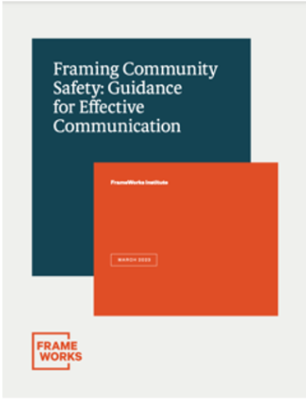
Framing Community Safety: Guidance for Effective Communication
|
|
With support from the Annie E. Casey Foundation, we partnered with FrameWorks Institute and released Framing Community Safety: Guidance for Effective Communication as a guide for productive conversations around violence prevention.
This comes at a time when Americans’ perceptions about crime and policing are increasingly divisive. |
|
|
The document offers strategies for nonprofits, community-based organizations, public agencies, and others who want to communicate more effectively about community-led efforts around three key concepts:
- Show people what community safety can look like
- Clearly explain the public health approach to community safety
- Name and explain social determinants of health and safety using plain language
Read more about our recommendations. |
|
|
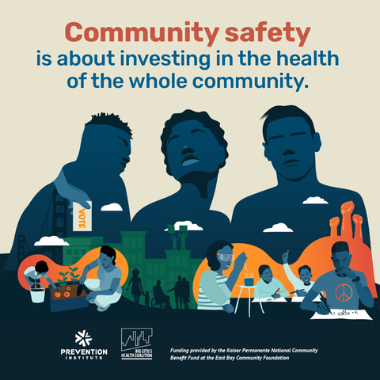
A safe community is one where we all can live, work, and play.
|
|
|
This year, with Big Cities Health Coalition, we uplifted research that shows equitable investment in our communities is what works to end violence. Safe communities have equitable access to
- affordable homes,
- parks and green spaces,
- living wages,
- quality education, and more.
|
|
|
|
But communities that have been most impacted by disinvestment because of systemic racism and class oppression have less access to these investments. You can help build safer communities by:
- supporting community-led solutions that improve health and well-being,
- holding policymakers accountable to create legislation that focus on violence prevention efforts that invest in community-led solutions, and
- learning how public health partners with communities to promote safety.
Join the movement for community safety and learn more.
|
|
|
Lessons Learned from the Evaluation of the Making Connections Initiative
|
|
|
Ruben Cantu, Associate Program Director, and Wil Crary, Associate Program Manager, recently co-authored “Situating for Success” in Health Promotion with Adolescent Boys and Young Men of Colour.
|
|
|
|
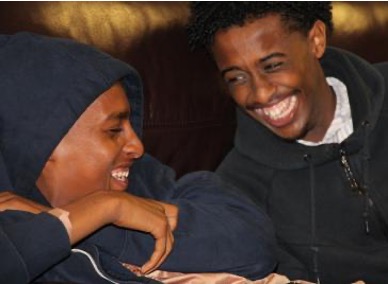
The chapter describes lessons learned about how the programs in the Making Connections Initiative built local implementation and evaluation capacity, and how evaluators can best work with similar programs.
The Making Connections Initiative, funded by Movember and facilitated by Prevention Institute, aimed to improve the mental health and wellbeing of men and boys of color through community-level, culturally-rooted, prevention-oriented mental health initiatives. Thirteen local programs in 11 states across the U.S. were funded to implement various mental health promotion strategies. You can access all resources that emerged through this initiative—including development frameworks, narrative tools, and strategies to sustain the work—in the Making Connections Backpack.
Read Ruben and Wil’s chapter.
|
|
|
Act now to invest in thriving communities:
|
|
- Attend ENACT Day 2023 Virtually. We’re joining community members and advocates from across California on Thursday, April 20 to promote a healthy, safe, and equitable California for all. ENACT Day brings advocates from across the state to educate legislators about health equity and racial justice policy priorities. For the first time in three years, ENACT Day will take place in-person in Sacramento. Join ENACT Day 2023 virtually.
- Urge Congress to fund REACH for FY2024. REACH (Racial and Ethnic Approaches to Community Health) is a CDC program that works to reduce health disparities among BIPOC populations. REACH recipients, including community-based organizations, universities, local health departments, tribal organizations, and cities, design and implement evidence-based programs to address the root causes of chronic disease and related risk factors. Sign on by April 11.
- Support funding of the Community Violence Intervention (CVI) Initiative. Join Big Cities Health Coalition, Prevention Institute, and Safe States Alliance in supporting a FY24 investment of $268 million—with $250 million dedicated to the Community Violence Intervention (CVI) Initiative—for Community and Youth Violence Prevention through the Division of Violence Prevention at the CDC. This investment would allow the CDC to support actionable, proven community-driven public health strategies that can prevent and reduce violence in communities facing the highest burden of violence. Sign on by April 11.
|
|
|