

Turning Inwards and Towards Community For Healing Justice
For BIPOC, LGBTQ+, immigrant, and many marginalized communities, the ongoing journey to envision and build a safe, joyous, and boundless existence requires Healing Justice. This is why the SHINE Learning Community integrates the power of healing in their local community work. Safety and Healing in Networks of Equity (SHINE) is a California initiative affirming resident leaders’ capacity to address domestic violence (DV) and intimate partner violence (IPV) in a culturally and contextually responsive manner. SHINE is composed of five collaboratives across northern, central, and southern California. The collaboratives work with distinct populations, e.g., BIPOC youth, Indigenous communities, etc., but share the same mission to prevent DV/IPV and promote safety and healing in their communities in a culturally responsive, context-specific manner.
Illuminating Connections Between Community Leadership and Healing Justice
In October 2024, SHINE collaboratives and Prevention Institute (PI) gathered to co-lead an exploratory and reflection space on healing justice, specifically what it looks like in practice within their communities. This session builds on a previous one about recruiting, cultivating, and sustaining community leaders. Community leaders galvanize collective healing and require their own healing to remain grounded.
Naming the Origins of Healing Justice
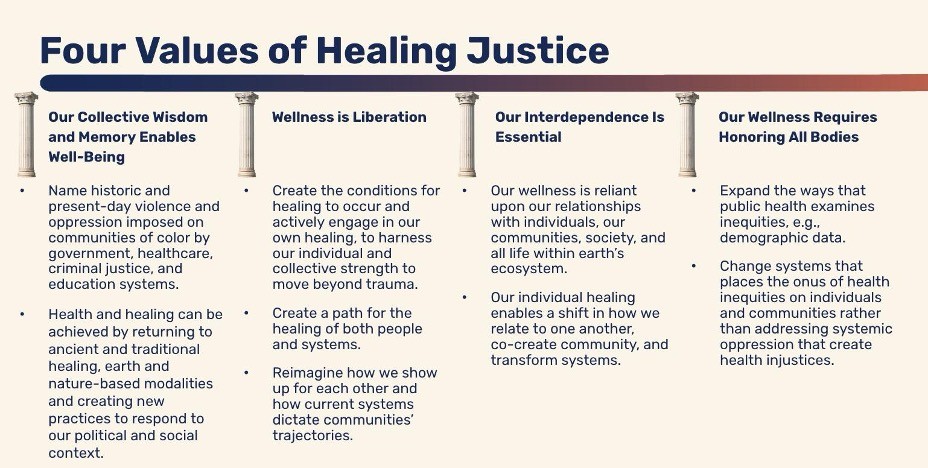
“Healing Justice” refers to processing and healing from generational trauma and systemic oppression towards holistic wellbeing. The term was coined and defined in 2005 by Kindred Southern Healing Justice Collective—a grassroots network that convenes southern organizers and healers to sustain communities and prevent isolation and burnout that accompanies anti-oppression work. According to their framework, healing happens on an individual and community level. The network developed the concept after years of working with anti-oppression healers to transform trauma and integrate healing in the southern United States. BIPOC organizers from the South built the foundation of their Healing Justice framework.
Four values of Healing Justice
Kindred Southern Healing Justice Collective’s Healing Justice definition encompasses four values:
- “Our Collective Wisdom and Memory Enables Well-Being”
- “Wellness is Liberation”
- “Our Interdependence Is Essential”
- “Our Wellness Requires Honoring All Bodies”
Besides naming core guiding principles, the framework emphasizes the role of oppressive structures, e.g., racism and capitalism, and the belief that we are our own and each other’s source for healing. The SHINE collaboratives naturally gravitated towards the first and third values, identifying immediate connections to their community work.
“Our Collective Wisdom and Memory Enables Well-Being”
The first value, “Our Collective Wisdom and Memory Enables Well-being” unpacks how historic and contemporary oppression persist in deliberately marginalized communities. It reaffirms the effectiveness of ancient and traditional healing. Over several years, United Women of East Africa (UWEAST) collaborative has validated the relevance of this value through their community work. Based in San Diego, UWEAST members are predominantly East African refugees, asylum seekers, and immigrants. Acknowledging their community’s lived trauma experiences, staff are creating and developing culturally responsive programming. They have increased their focus on somatic healing through their Oasis program, which has held holistic, cultural programming like dance, nutrition education, and community gatherings. UWEAST girls recently attended a Buraanbur workshop, a traditional Somali cultural dance. The dance incorporates healing mantras to uplift the beauty of womanhood through movement and joy. UWEAST believes community is medicine.
“Our Interdependence is Essential”
The third value, “Our Interdependence is Essential” highlights how communities and individuals need to rely on each other to survive and thrive. It is imperative to shift how we understand and relate to each other as interconnected. Mujeres Poderosas Amorosas (MPA) and The Center at McKinleyville shared how the value is embedded in their work. MPA’s Latina facilitate community pláticas, i.e., Spanish for conversation, in their neighborhood and leverage social media channels to build deeper connections. MPA members are growing their advocacy and conflict resolution skills through the Powerful People curriculum. The cohort of women are supporting each other as they identify issues to uplift in Fresno.
The Center at McKinleyville, similar to MPA, believes interdependence is foundational to their work and partnerships. Their region is a progressive, diverse Native town on the coast. They are currently working on a block party program, which will fund 10 local community groups to throw block parties with a commitment to the Center’s Safety Policy. The policy promotes, “. . . a culture of healthy relationships with the premise that systems and community-based organizations need to model healthy relationships in order to influence community norms.” Collaborative members value and practice solidarity especially among marginalized identities, e.g., Indigenous women and femmes.
Weaving Healing Justice into Our Collective Future
In October 2024, SHINE collaboratives reaffirmed their interest in healing justice within their communities. The group discussion made clear that facilitating healing dovetails with addressing the root causes of IPV and DV. SHINE collaborative leaders spoke about the value of drawing on cultural traditions, including traditional dance and poetry and community gatherings, as healing, and preserving these practices even if they run counter to the dominant Western culture in the United States. It is an individual and collective journey to transform structural oppression and generational trauma. SHINE collaboratives demonstrate how they continue to turn inwards and towards community for strength and healing. Following this emergent theme, our learning community is open to continue learning about the lineages and practices of healing justice.