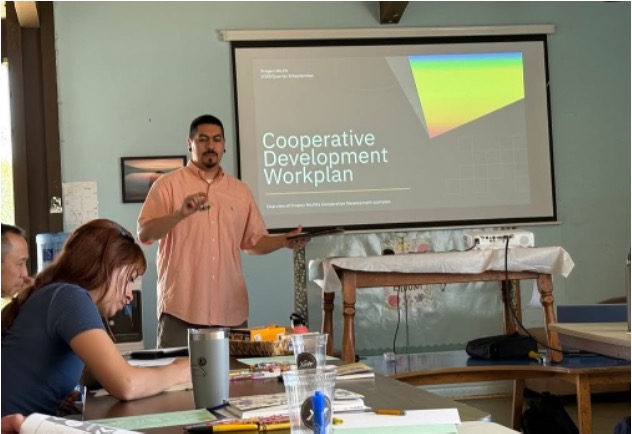
Man presents Cooperative Development Workplan slide to small group in meeting room while participants take notes at table.

Imagining Possibilities for an Equitable Future

                                                                     DECEMBER 2025 

People, Parks, and Power (P3) Newsletter 

A national initiative for green space, health equity and racial justice 

A diverse group of adults and one child pose together indoors for a group photo. They are standing and seated in front of a large, colorful mural that includes trees, people, eyes, and symbolic imagery related to community and nature. The group appears relaxed and smiling, suggesting a community gathering or workshop. A table with a water bottle and wrapped food sits in the foreground.

P3 members and organizers from Comité MILPA, a group of agricultural worker leaders convened by CAUSE, MICOP, and Líderes Campesinas.

Imagining Possibilities for an Equitable Future

Dear Members of our P3 National Network, 

As 2025 draws to a close, we continue to find hope in the essential work our Local Partners are doing to build community power and advocate for their communities’ health. In the face of inhumane policies and ongoing attacks, our collective work has made it clear that we remain steadfast in the fight for health equity, environmental justice and racial justice

Driving this determination is the belief in a better future. In this edition of our newsletter, my colleague Grace Cotangco shares how we can reimagine our public health systems in ways that, finally, put people first. In his featured story, our Local Partner Agustin Vega describes how he draws inspiration from the progress Indigenous women leaders in East Oakland have made towards reclaiming and restoring their ancestral land. Their work reminds us all that equitable, sustainable and communal land ownership is within reach.   

These stories live within this spirit of bold reimagination, even in the face of what feels impossible. As we continue to build a national movement to advance park equity, we hold firmly to the belief that it is through centering people that we can achieve a just future for all. Thank you for being on this journey with us. 

—Sandra Viera

Director, Prevention Institute and lead, Prevention Institute’s People, Parks, and Power Initiative (P3)


A Call to Reimagine Public Health

By Grace Cotangco, P3 Program Manager     

In early November, I had the opportunity to represent P3 as the invited speaker for two sessions at the American Public Health Association Annual Meeting in Washington, DC. The conference’s opening session, titled Mission Possible, was an invitation for attendees – all 11,000 public health professionals and scholars – to persevere in the work to make the public’s health a national priority, especially in a year that has seen some of the most established and relied upon public health institutions and policies under attack

What would it look like to respond to this invitation? 

Some advocates are doubling down on defending the systems and institutions we've come to rely on, which is necessary to safeguard communities and protect people's health as much as possible. But making the public’s health a national priority requires that we transform our current flawed and precarious systems entirely instead of rebuilding a copy of what stood before. 

Parks serve as reminders of these flawed systems: they are physical representations of where power lies in communities. The park inequities experienced by Black, brown, Indigenous, and low-income communities are the outcome of discriminatory practices and racist policies that have compounded on and reinforced one another for decades. To this day, whoever influences community decisions and policies determines where parks and green spaces are, who they’re for, and what they offer. And this effect isn’t unique to parks and land access; we see consistent inequities in adjacent issues such as food security, community displacement, and environmental justice. 

P3 Local Partners are working to uproot broken systems and start building new ones grounded in justice. For the past four years, our P3 partners have been advocating for healthier communities and unearthing policy solutions that advance park and green space equity. They're also building lasting decision-making power and influence among the people who are most impacted. In communities across the country, Local Partners are planting the seeds of hope for a future of just systems and policies to replace the ones that have harmed them for so long.


Rematriation, as I understand it, is the practice of restoring Indigenous peoples’ sacred relationship to their ancestral land. This work can be both spiritual and healing, encompassing the return of and to ancestral land, supporting returns to tradition and cultural knowledge, and undoing the harmful and violent legacy that patriarchal systems continue to have.

A man stands at the front of a room presenting to a small group, gesturing as a slide titled “Cooperative Development Workplan” is projected on a screen behind him. Several participants sit at tables in the foreground with notebooks and materials, listening and taking notes during the workshop.
Agustin presenting to the Project MILPA team during a staff retreat 
Photo Credit: CAUSE

I have been thinking about this since this past spring, when I had the privilege of hearing Corrina Gould, co-founder of the Sogorea Te’ Land Trust, speak at the People, Parks, and Power (P3) annual convening. She shared the story of how the Ohlone, and other members of the Confederated Villages of Lisjan, have belonged to the California Bay Area since time immemorial. Through eras of Spanish colonization and missionaries, the Mexican government, and the U.S. government, they have been continually dispossessed of their land. She and other Ohlone people are now reclaiming and rematriating their land, one site at a time. 

As part of the P3 initiative, I coordinate Project MILPA (Misión Independencia Logrando Poder y Aprendizaje) in support of agricultural workers in Ventura County, a fertile agricultural region in California’s Central Coast that is the nation’s primary provider of foods like strawberries, lettuce, and lemons. The United States food system relies on the thousands of agricultural workers who plant, seed, prune, harvest and pack the crops. Agricultural workers in this region are largely Latine and Indigenous, including many migrants from Southern Mexico who primarily speak Indigenous languages, such as Tu’un Savi (Mixteco). 

For decades, wealthy farming families and big agricultural corporations have exploited these farms and the workers who cultivate them. These companies have created an unsustainable food system that depletes the land, while creating and maintaining exploitative, dangerous work conditions. When agricultural workers are able to escape those conditions and become farm owners, they usually end up renting the land they work on and selling their goods to the big businesses that control the distribution channels. 

We know that a better system is possible: one that advances environmental sustainability, racial equity, and economic transformation in the food system by improving the California agricultural system into one where land is owned more equitably and communally. In that system, agricultural workers will be able to steward the land, earn a living wage, and provide for themselves and their families. These are all parts of our vision in Project MILPA (Misión Independencia Logrando Poder y Aprendizaje), where we promote land stewardship practices that support sustainable agriculture, explore farmworker-to-farm owner pathways, and propose new ownership models such as cooperatives, community land trusts and conservation easements. We also advocate for policies that support equitable access to farmland and prevent its consolidation by private equity, hedge funds, and venture capital.

“We know that a better system is possible: one that advances environmental sustainability, racial equity, and economic transformation in the food system by improving the California agricultural system into one where land is owned more equitably and communally.”

I find connections between the work of rematriation and the challenges Project MILPA faces around land access, the foremost being the foundational fact that corporate agricultural land ownership in our area is even an option only because it is stolen land from Chumash people. Discussions about land ownership must center this part of our history because to ignore it is to be complicit with settler colonialism and to continue the historical erasure of people who have ancestral ties to this land. 

These days, Project MILPA’s work to democratize business and land ownership feels both overwhelmingly difficult yet necessary, as the federal government targets agricultural workers and those in our communities. The United States Immigration and Customs Enforcement (ICE) conducted a raid in Ventura County this summer, kidnapping more than 350 agricultural workers. To this day, ICE continues to have a heavy presence in California and is moving into new cities across the country. With Congress passing an enormous allocation of funds to ICE, a massive detention and deportation system is being created and communities are gearing up for a large increase in ICE activity: more kidnappings, family separations, and state-sanctioned violence.

Agricultural worker in Oxnard, CA. 
Photo Credit: Lideres Campesinas
It can be hard to see the road that lies ahead towards land justice and healing, and in times of doubt I reflect on Corrina’s work of rematriation - that the work of reclaiming power, reconnecting with culture and traditions, and restoring relationship with land is continual work that can take generations. One thing that is certain is that all the different people who have stewarded these lands have a deep history of community organizing and resistance. We’ve seen it in the Chumash people who revolted against the mission system in the 1800s. We saw it in the Japanese and Mexican agricultural workers who created the first multiracial farmworkers union in 1903. We continue to see it today and beyond, as agricultural workers - and the community that supports them - organize for their right to be, their rights to thrive, and their rights to belong. 
Agustin Vega is the Project Coordinator for Project MILPA, which is a People, Parks, and Power initiative and a collaboration between the Central Coast Alliance United for a Sustainable Economy (CAUSE), Mixteco Indigena Community Organizing Project (MICOP), and Lideres Campesinas. He previously worked as a Workers’ Rights attorney with Legal Aid Services of Oregon - Farmworkers’ Rights program and is a current fellow with the Sustainable Economies Law Center. 
 

For more information regarding Project MILPA, please reach out to agustin [at] causenow.org (agustin[at]causenow[dot]org)

More from P3


Check out our past newsletters and P3 [at] PreventionInstitute.org (drop us a line) to let us know what you’d like to see featured in future issues.

Need Our Help?

We’ve got more than 25 years of experience supporting community collaboratives, practitioners, funders, and jurisdictions. Check out our services and reach out.