|
14 organizations across the U.S. awarded $500,000 grants to advance park and green space equity
|
|
Prevention Institute is honored to introduce the inaugural cohort funded through the People, Parks, and Power (P3) national initiative. P3 is the first national funding initiative in the U.S. to support power building by community-based organizations to reverse deep seated park and green space inequities in Black, Latino, and Indigenous communities across the country. It is a joint effort of the Robert Wood Johnson Foundation and the Doris Duke Charitable Foundation, led and managed by Prevention Institute.
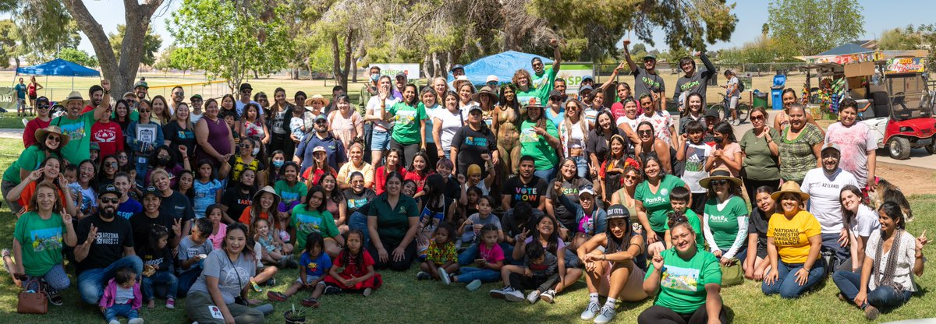
Fourteen dynamic groups have been awarded $500,000 over two years to organize diverse youth, residents, and working class and farmworker families to advocate for park and green space equity in cities throughout the continental U.S. and Puerto Rico. Together, the funded partners will advance national momentum toward an equitable future, addressing community priorities central to the environment, health, and racial justice.
|
|
“On behalf of all of us at Prevention Institute, we are honored to partner with these fourteen creative, energetic, and resourceful groups who have demonstrated the capacity to work with residents to meet and overcome the injustices they face through rigorous organizing, power building, and policy advocacy. Our aim is to bring these skills and strategies to bear on the structural roots of park and green space inequities as part of our broader agenda to fulfill the promise of health equity and racial justice for all Black, Latino, and Indigenous people.” —Manal J. Aboelata, Deputy Executive Director and P3 Co-Director, Prevention Institute
|
|
| The need for this initiative was evident, with more than 450 applicants across 45 U.S. states and territories. The P3 grantees represent diverse locations, people, and perspectives; with influence from Black, Latino/a, Afro-Latino, Indigenous Mexican, Native American, youth, queer, and women leaders. These unique organizations are making connections between park equity and other pressing community issues—like affordable housing, climate resilience, COVID-19 recovery, environmental justice, farmworker rights, food security, Indigenous sovereignty, racial justice, safety, youth engagement—to develop meaningful solutions tailored to their communities. |
|
| “In the future, we hope to see increased levels of investment in this type of work and these kinds of organizations. In order for the transformation we envision to occur, effective and credible organizations like the fourteen P3 partners who are now part of this groundbreaking initiative need to be supported in ways that amplify local resident leadership and allow their work and their impact to grow and flourish into a national groundswell for park and green space equity.”—Elva Yañez, Parks, Land Use, and the Built Environment Senior Advisor and P3 Co-Director, Prevention Institute |
|
Meet the inaugural P3 cohort, who will spend the next two years building community power and advocating for local policy and systems changes to advance park and green space equity.
- Central Texas Interfaith Sponsoring Committee (Austin, TX) will apply their successful community organizing and power building model to advance park equity in the historically Latino and Black neighborhoods of East and South Austin—communities with green space deficits that face displacement threats.
- South Bronx Unite (Bronx, NY), an environmental justice organization building community power in the predominantly Black and brown neighborhoods of the South Bronx, will advocate for city-level policy and systems changes, and increased funding for green spaces in frontline communities through their Community Land Trust.
- One Love Global (Detroit, MI), a Black-led, youth power building organization will organize Black youth and increase their voice in city government decision-making on green space and environmental justice issues.
- Communities in Partnership (Durham, NC), a Black- and women-led organization, will organize residents of the majority Black and Latino neighborhoods of East Durham to build a policy agenda that centers the lived experience of those marginalized by the current approach to parks and green space.
- Make the Road Nevada (Las Vegas, NV), a member-led organization that builds power with Latino and working-class immigrant communities, will organize residents of Las Vegas’ East and North sides to advocate for policies that increase green space, combat extreme heat, and center historically underrepresented communities in local public infrastructure and development policies.
- Physicians for Social Responsibility – Los Angeles (Los Angeles, CA) will organize South LA’s predominantly Black and Latino communities to assess environmental and health burdens associated with contaminated lands, and advocate for policy and systems changes to institutionalize community-centered remediation of brownfields into healthy green spaces in frontline communities.
- Hope Community (Minneapolis, MN), a multiracial organization that mobilizes Black, Indigenous, and people of color for policy and systems change, will continue their long-standing work advocating for policies, metrics, practices, and narratives that support racial equity in Minneapolis’ park system.
- Water Collaborative of Greater New Orleans (New Orleans, LA) will advance stormwater equity in an effort to mitigate flooding in New Orleans, especially in the city’s low-income Black neighborhoods, and create more green spaces in high need communities.
- Central Coast Alliance for a Sustainable Economy (Oxnard, CA), with Mixteco Indigena Community Organizing Project and Lideres Campesinas, will organize farmworkers—including Mexican immigrants and Indigenous Mexicans—in Ventura County and advance local land use policies that increase access to parks and green space.
- Chispa Arizona (Phoenix, AZ) will organize and build power among Phoenix’s Latino residents to advance policies and development practices that combat extreme heat and advance green space equity.
- Colectiva Feminista en Construcción (San Juan, PR), a grassroots organization led by Black queer women, will organize the Río Piedras community to identify policies that address decades of systematic neglect and austerity measures, promoting collective ownership over public space and increasing green space.
- Chainbreaker Collective (Santa Fe, NM), a member-led economic and environmental justice organization, will explore and advocate for models that increase community control over local development, fight displacement, and increase access to green space.
- California Indian Museum and Cultural Center (Santa Rosa, CA), a Native American led cultural organization, will work with Pomo and Miwok youth to create a Native cultural gathering policy to improve access to—and culturally sensitive stewardship of—regional parks for Sonoma County’s Native American communities.
- The Conscious Connect Community Development Corporation (Springfield, OH), a Black-led organization that reimagines and redevelops underutilized public spaces for health, education, peace, and culture, will organize residents to advocate for city policies and processes that remove barriers to creating parks and activating vacant spaces, and ensure future developments include provisions for parks and green space.
|
|
Join our growing network of park equity advocates and be the first to learn about upcoming webinars and national network-building opportunities! For more information about the People, Parks, and Power (P3) initiative, contact P3 [at] PreventionInstitute.org (P3[at]PreventionInstitute[dot]org). For media inquiries, contact LySaundra [at] PreventionInstitute.org (LySaundra[at]PreventionInstitute[dot]org).
Funding for this project is provided by the Robert Wood Johnson Foundation and the Doris Duke Charitable Foundation. The views expressed here do not necessarily reflect the views of the Foundations. |
|
|